

Photos Provided
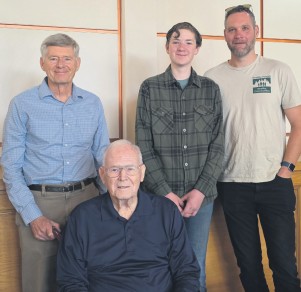
Four Generations together: Bob O’Neill, Senior, (front row), (Left to right back row) Bob O’Neill, Jr., Enan and Brendan VanderVelde.
By Cynthia Mudge
For the C-C Chamber of Commerce
For nearly eight decades, Hemphill-O’Neill Company has navigated the highs and lows of the timber industry through long-term planning, adaptability, and a commitment to family values.
Representatives from the Centralia-Chehalis Chamber recently sat down with representatives from four generations – Bob O’Neill Sr., Bob O’Neill Jr., Loretta O’Neill, Brendan VanderVelde, and Enan VanderVelde – to discuss the company’s history and the family legacy that continues to shape its future.
Founded in 1947 by Alan Hemphill and Harold O’Neill, the company began as a brokerage firm that connected small timber operators with buyers. Over time, the business expanded into mill operations, transforming logs into finished products used in home construction and other industries.
In 1971, Harold O’Neill’s son, Bob O’Neill, Sr., and his wife, Doris, became partners in the business alongside Alan Hemphill’s Son, John. The partnership continued for more than four decades before ownership transitioned fully to the O’Neill family in 1985, when the Hemphill family sold their interest in the company.
Today, Hemphill-O’Neill Company remains a family-owned enterprise spanning four generations. Bob O’Neill Sr., now 98 and long retired, passed leadership to Bob O’Neill, Jr., who became chief executive officer in 2002. Family members continue to play active roles in the company, including 15-year-old Enan VanderVelde, who represents the fifth generation to work in the business.
The timber industry requires a unique perspective on planning. While many businesses operate on seasonal cycles, forestry demands decisions that stretch across decades.
Trees planted today may not be harvested for 40 years or more. Forestlands require ongoing management, including planting, thinning, and harvesting on a rotating basis. Like the forests they steward, family businesses such as Hemphill-O’Neill must also think generationally.
Succession in a family business is also about planning decades ahead. To do that, they have internally mapped out potential successors, which include both O’Neill family members and in-laws such as the VanderVeldes, who are heavily invested in the day-to-day operations.
Throughout its history, the Hemphill-O’Neill Company has adapted to significant changes within the industry. During its peak years, the company’s largest customers were railroads that relied on wood for railroad ties and boxcars. At one point, the company employed approximately 300 people in its mill operations and in 1975 the Hemphill-O’Neill Company was listed among the top 100 lumber producers in the U.S. and Canada (The Forest Industries report, May 30, 1975).
As markets evolved, so did the business. Hemphill-O’Neill responded to advances in technology, shifting environmental priorities, changing regulations, and fluctuations in the economy. The company also included innovative products, such as a tongue and groove roofdeck system that fused wood slats using a vertical nailing process. Samples of this product remain on display at the company’s office today.
Like many long-standing businesses, Hemphill-O’Neill has weathered difficult periods. Bob O’Neill Sr. identified 1985, when ownership changes were underway, as one of the company’s most challenging years.
The company also faced a significant legal battle that would have allowed larger corporations to influence pricing structures in ways that threatened small timber operators.
More recently, the COVID-19 pandemic created unexpected opportunities for the lumber industry. Increased home renovations, new construction, and the rise of remote work drove demand for building materials as homeowners expanded and improved their living spaces.
Across each generation, family members have started their careers by learning the business from the ground up. Earlier generations began by sweeping mill floors, while today’s younger family members gain experience by planting and managing trees.
Community involvement remains a cornerstone of the company’s mission. Hemphill-O’Neill dedicates 5 percent of its profits to philanthropic efforts that support local organizations and initiatives.
Recipients of the company’s support include Boistfort Fire District 13, Lewis County Work Opportunities, the Pacific Northwest Chamber Orchestra, the Centralia College Foundation, the Centralia Christian School Foundation, and numerous education, youth, and industry programs.
When asked what they hope people understand about their work, Brendan VanderVelde emphasized the connection between responsible forestry and strong communities.
“We hope forestry can be seen in a more positive light—to show that forestry is about keeping forests healthy,” VanderVelde said. “A healthy forest means a healthy community.”